Insights >
Most Popular Search Engines in Japan | 2026 Edition


New: LINE Yahoo Ads Media Guide | download for FREE >>
Japan’s search engine landscape has undergone the most dramatic shift of any major market in 2026, with Bing’s share exploding from single digits to roughly a third of all searches — while Google still leads and Yahoo! JAPAN’s role has quietly shifted from “search rival” to ecosystem powerhouse.
Table of Contents
According to StatCounter, Google held 59.73% of Japan’s overall search market in July 2026, with Bing at 32.07% and Yahoo! JAPAN at 6.55%, followed by DuckDuckGo, Yandex, and CocCoc making up the rest.
This marks a seismic change from just 18 months earlier: as recently as early 2025, Google commanded roughly 82% of Japanese search, Yahoo! JAPAN held around 9-10%, and Bing sat under 8%. Multiple independent trackers confirm the same trend.
If you are advertising in Japan, it is absolutely crucial to adapt a dual platform strategy. Read our blog to learn more about successful strategies here →

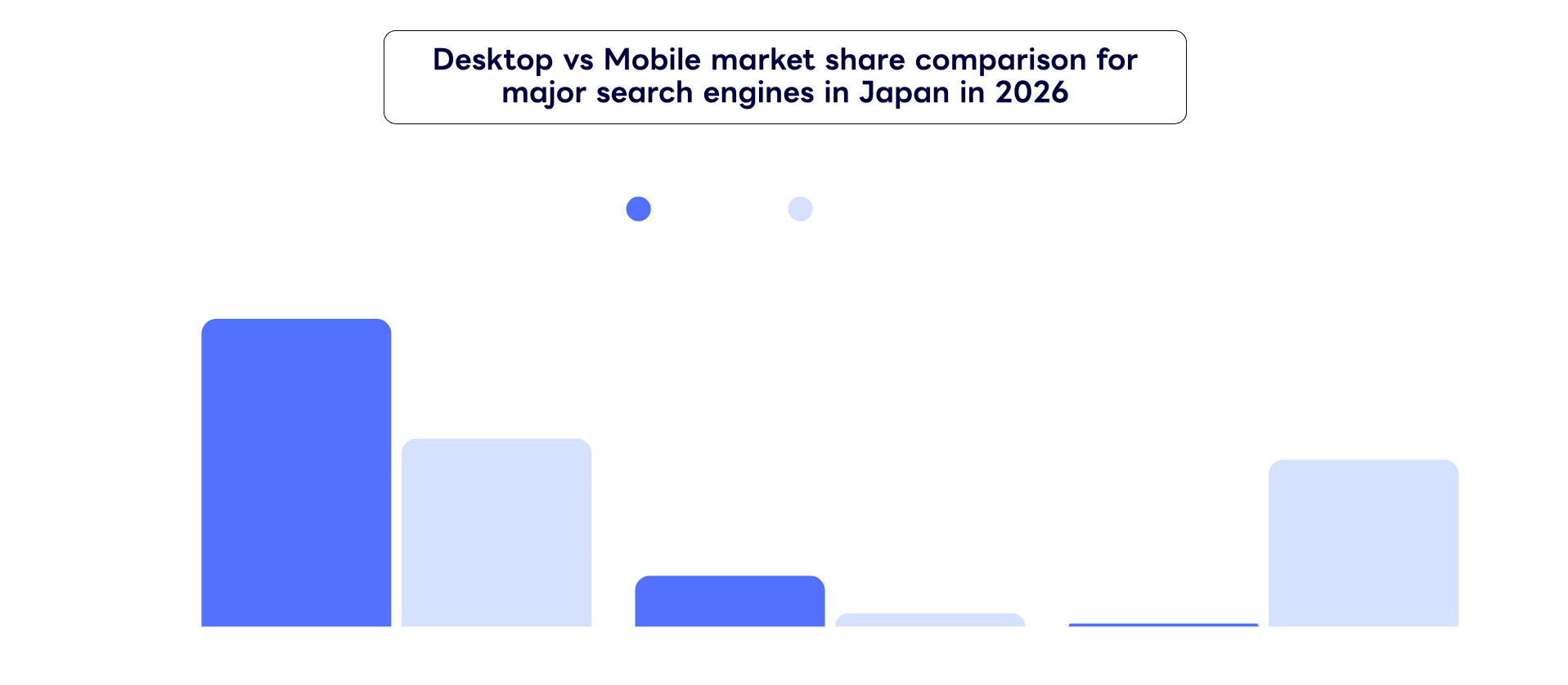
Bing’s rise in Japan is almost entirely a desktop and enterprise phenomenon, not a shift in everyday consumer behavior. On desktop alone, Bing reached 44.83% versus Google’s 50.46% in July 2026, nearly closing the gap with Google on PCs.
On mobile, however, Bing remains negligible at just 0.83%, while Google still commands 84.29% of mobile search and Yahoo! JAPAN holds a stronger 12.22% mobile share. Since mobile accounts for the large majority of Japanese search volume, this means Bing’s headline number overstates its impact on everyday consumer search behavior.
Three structural drivers explain the surge:
There is also a data-quality dimension worth flagging: StatCounter rolled out significantly improved bot detection in February 2026 after acknowledging “a significant rise in bot traffic to websites”. It had been inflating certain desktop search readings across markets, including automated scraper traffic misclassified as genuine desktop sessions.
While Japan’s Bing surge is corroborated across multiple independent sources and device breakdowns (making it a real, not purely artificial, shift), analysts researching China’s search data have shown that Bing “surges” tracked by StatCounter elsewhere were partly driven by LLM scraper bots mimicking desktop browsers. The practical takeaway for Japan is that Bing’s growth is genuine and enterprise-driven, but its true weight in consumer-facing SEO remains far smaller than the desktop number alone suggests, since desktop is a minority of total search volume in Japan.
Yahoo! JAPAN maintains the strong second position on mobiles with nearly 14% market share, while Bing has captured less than 1% of searches.

Yahoo! JAPAN’s standalone search share is roughly 14% on mobile, but this number dramatically understates the platform’s real influence in the Japanese market. Yahoo! JAPAN’s web search has run on Google’s underlying search algorithm since 2010, meaning its organic results are already Google-powered. There is effectively no separate “Yahoo! JAPAN SEO” to pursue outside of standard Google optimization.
What sets Yahoo! JAPAN apart is reach beyond search: the platform has approximately 89 million monthly active users, with over 80% of Japan’s internet users engaging with it at least once a month. It continues to hold the largest PC user base and second-highest mobile user base of any platform in Japan.
This scale comes from its role as a comprehensive digital portal spanning news, shopping, finance, Q&A and – since its recent corporate integration – LINE messaging, creating an ecosystem of daily touchpoints that a pure search engine cannot replicate.
On 1 April 2026, LY Corporation completed the full integration of LINE Ads and Yahoo! JAPAN Ads into a single unified platform called LY Ads, consolidating display, search, and native ad formats across both properties into one Business Manager and one interface.
Download our free LINE Yahoo Ads Media Guide here →

For advertisers, this reframes Yahoo! JAPAN as fundamentally a portal, ads, and ecosystem decision rather than an SEO one, while Google’s SEO fundamentals still apply to the search results Yahoo! JAPAN displays.
Meanwhile, Yahoo! JAPAN Ads continues to offer lower CPC and CPA due to reduced advertiser competition versus Google, and its LY Ads network of LINE + Yahoo! JAPAN properties (Talk List, LINE NEWS, LINE Manga, Yahoo! JAPAN homepage, news, sports, finance, and hundreds of partner publisher sites) gives brands multiple daily engagement touchpoints beyond search alone.
Google’s AI Overviews are also reshaping the Japanese search experience: as of a January 27, 2026 update, AI Overviews run on Gemini 3 by default, letting users ask follow-up questions and move directly into AI Mode from a generated answer, with no special markup required beyond standard indexing and crawlability best practices. As of 2026, AI Overviews appear on an estimated 5-15% of all searches, most often for informational, health, and technology-related queries.
💡Run one Google-quality SEO programme in native Japanese
Google’s ~60% share plus the fact that Google-powered results also drive Yahoo! JAPAN’s organic search means well over 60% of Japanese search ultimately resolves against Google’s index.
💡Add Bing technical hygiene if selling B2B or targeting corporate buyers
A meaningful share of Japanese business decision-makers now see Bing results during working hours, so basic Bing Webmaster Tools setup and ranking spot-checks are worth the low cost.
💡Run parallel PPC campaigns on Google Ads and LY Ads (Yahoo! JAPAN/LINE)
This dual-platform approach remains standard practice for serious market entry, since LY Ads offers integration across LINE’s messaging reach and Yahoo! JAPAN’s portal ecosystem that Google Ads cannot replicate.
💡Monitor, but don’t overweight, Bing’s headline share
Because Bing’s gains are concentrated on desktop and enterprise use cases rather than the mobile-first consumer searches that dominate everyday Japanese shopping and information behavior.
Japan’s search engine evolution differs significantly from Western markets. Yahoo! JAPAN launched in 1996 with strategic backing from SoftBank CEO Masayoshi Son, rapidly becoming the dominant portal site during the early internet era.
Google entered in 2000, and by 2010, Yahoo! JAPAN adopted Google’s search technology while maintaining its independent advertising platform and user ecosystem.
This historical foundation explains why Yahoo! JAPAN retains substantial influence despite using Google’s search algorithms. The platform evolved beyond search into a comprehensive digital ecosystem encompassing news, shopping, finance, and social features.
Japanese search behavior reflects deeper cultural preferences for trusted, established platforms. Brand loyalty plays a crucial role, with Yahoo! JAPAN benefiting from over two decades of localized service development.
The platform’s integration with daily services—from Yahoo! JAPAN Shopping to Yahoo! JAPAN Chiebukuro (Q&A platform)—creates user stickiness that pure search algorithms cannot replicate.
While it may not command the largest search engine market share, its reach is unprecedented. A Nielsen study reveals that Yahoo! JAPAN boasts a massive user base, averaging 83.35 million monthly users in 2024, placing it a close second to Google’s 84.60 million.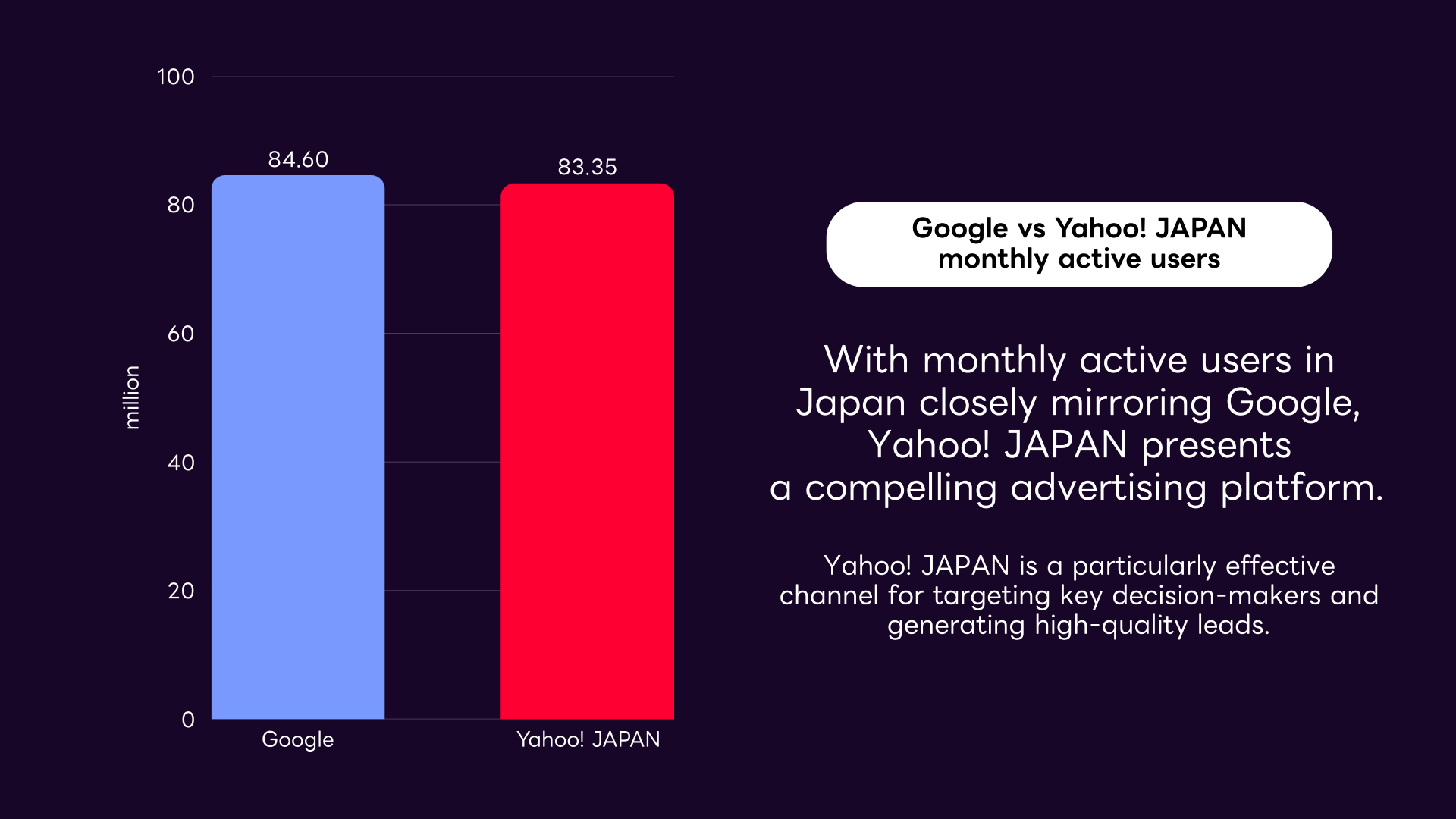
❗️ Language complexity: Japanese incorporates hiragana, katakana, and kanji characters, affecting keyword strategies.
❗️ Local content preference: Users favor platforms offering Japan-specific information and services.
❗️ Trust and reliability: Established brands command higher user loyalty than in Western markets.
Google Japan leverages its global infrastructure while adapting to local preferences. The platform excels in mobile search, benefiting from Android’s prevalence and default iOS integration. Google’s strength lies in its advanced AI capabilities, comprehensive ad targeting options, and seamless integration with international business tools.
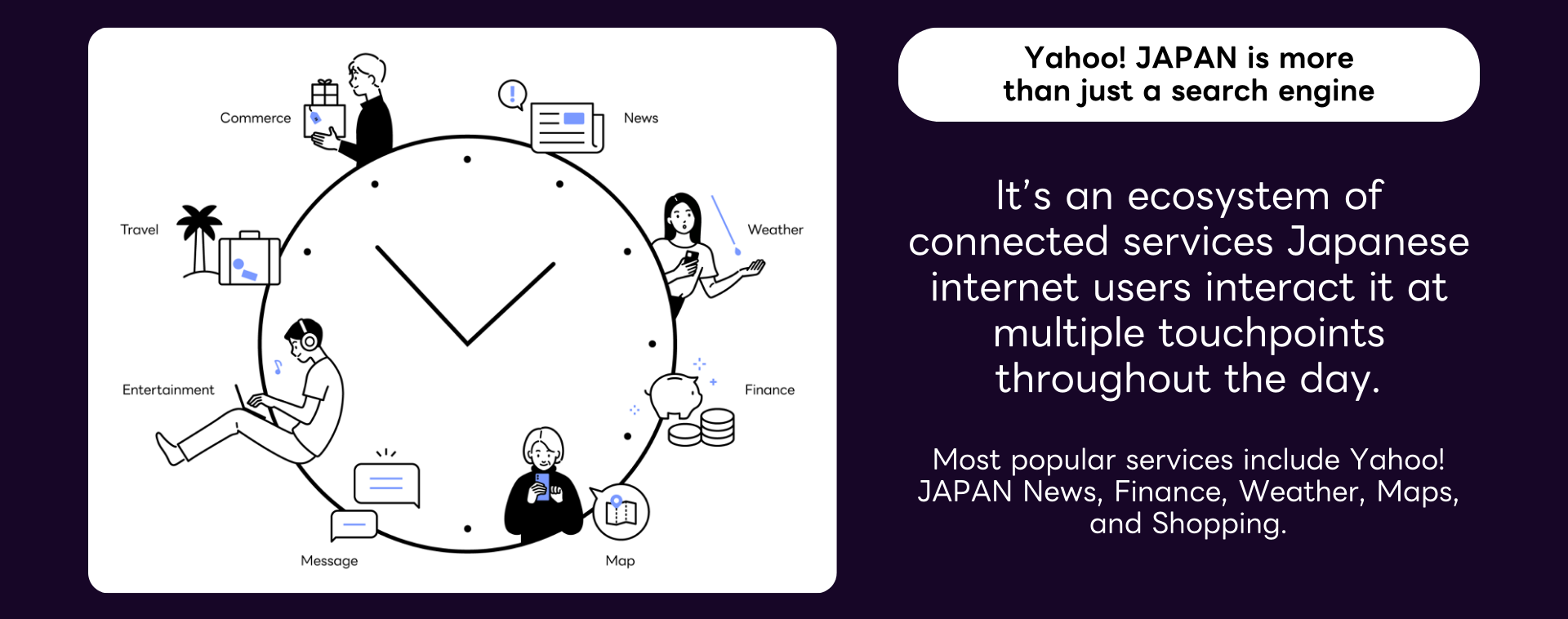
Yahoo! JAPAN operates as more than a search engine – it functions as Japan’s primary digital portal. With 54 million monthly logged-in users and integration across SoftBank’s telecommunications network, the platform maintains strong local relevance.
Yahoo! JAPAN’s ecosystem approach creates multiple touchpoints throughout users’ daily digital interactions.
The platform’s unique value proposition extends to advertising, where lower competition often results in better cost-per-click rates compared to Google. This advantage makes Yahoo Japan particularly attractive for businesses targeting older demographics or B2B markets.
Bing’s presence in Japan centers on desktop users and business environments. As Microsoft’s default search engine, Bing benefits from Windows integration and corporate network usage. The platform’s recent growth correlates with increased AI interest, particularly following ChatGPT’s popularity surge in 2024.
While Yahoo! JAPAN uses Google’s search algorithms, the platforms display different search result features and user engagement patterns. Yahoo! JAPAN emphasizes portal-style results with integrated shopping and Q&A content, while Google focuses on minimalist search experiences with rich snippets and AI overviews.
✅ Universal Approach: Google algorithm optimization benefits both Google and Yahoo! JAPAN.
✅ Content Differentiation: Yahoo! JAPAN users prefer practical, everyday content while Google users engage with trending, tech-focused topics
✅ Local Integration: Yahoo! JAPAN’s ecosystem requires integration with shopping, news, and community features.
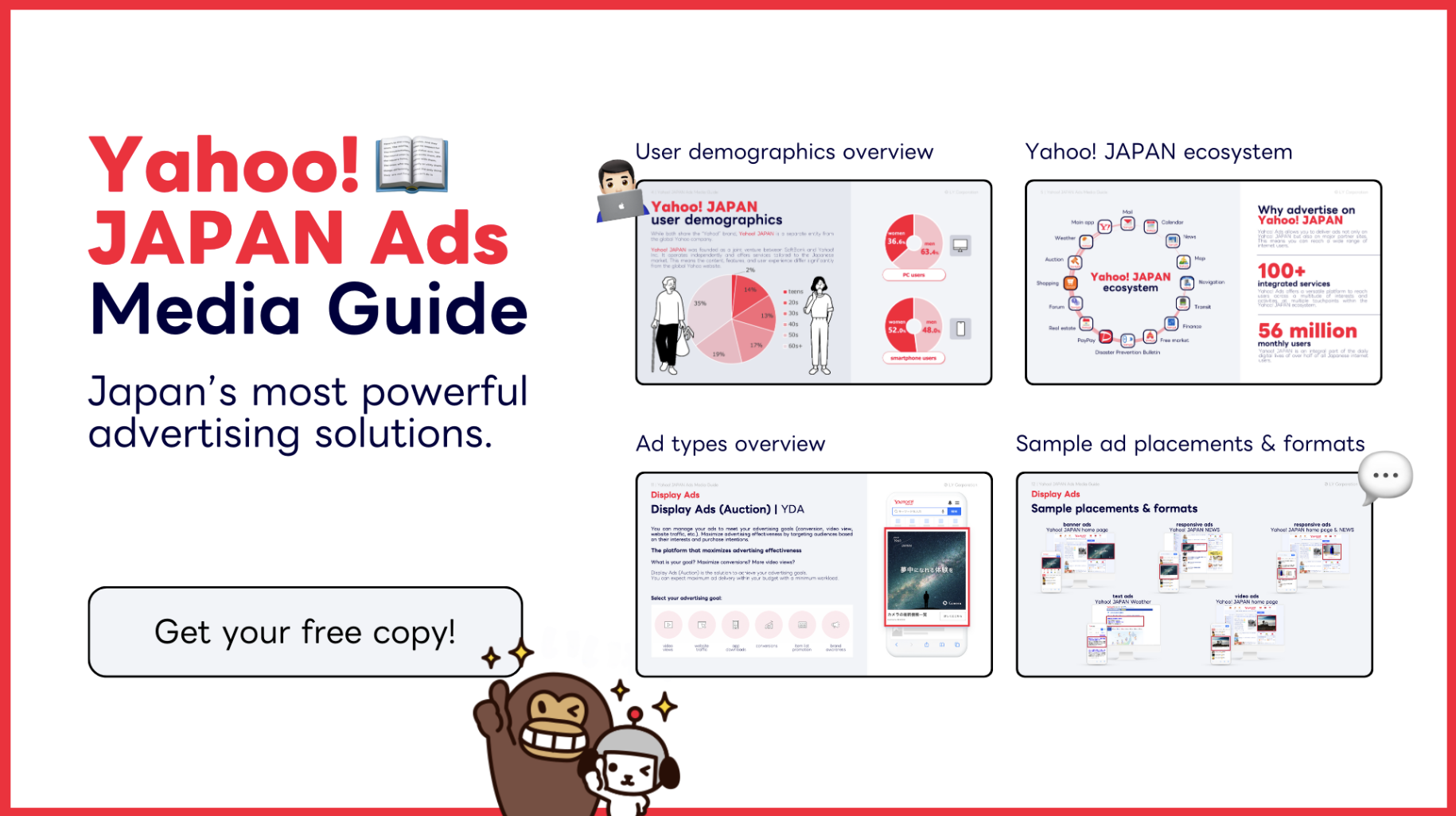
Download our free Yahoo! JAPAN Ads Media Guide to learn more about advertising on the platform.
The advertising landscape reveals significant differences in targeting capabilities, audience reach, and performance metrics. Google Ads provides international integration and AI-driven optimization, but Yahoo! JAPAN Ads offer better local targeting and lower competition.
✅ Cost Efficiency: Yahoo! JAPAN often delivers lower CPC and CPA due to reduced competition.
✅ Audience Reach: Google provides broader demographic coverage while Yahoo! JAPAN excels in specific age segments
✅ Integration Opportunities: Yahoo! JAPAN’s partnership with LINE creates unique cross-platform targeting possibilities.
Japan’s search engines are rapidly adopting AI technologies, with implications for both search results and advertising effectiveness. Google’s AI Overviews are expanding in Japan, while Yahoo! JAPAN is testing AI-generated answers on mobile devices. Bing’s early AI integration has contributed to its desktop market share growth.
The continued shift toward mobile search usage strengthens Google’s market position while creating challenges for desktop-focused platforms like Bing. Mobile device usage in Japan averages 106 minutes daily, with smartphone penetration reaching 85% of the population.
The integration between Yahoo! JAPAN and LINE, following their corporate merger, creates new advertising and targeting opportunities. This ecosystem approach – combining messaging, shopping, news, and search -represents a uniquely Asian model for digital platform development.

Running PPC campaigns on both Google and Yahoo JAPAN is necessary for any brand advertising in the Japanese market. It helps to have expert knowledge of market trends, Japanese internet user behaviour and experience running campaigns in Japan.
We are official media representatives for LINE Yahoo advertising products and provide clients with free support. Contact our team today to discuss how we can help you start advertising on Yahoo! JAPAN.