Insights >
Understanding Japanese Consumer Behaviour in 2026: A Practical Guide for Marketers

New: 2026 Japanese Marketing Calendar | download for FREE >>
Japanese consumer behaviour in 2026 is being reshaped by demographic change, cost-of-living pressures, and rapid digitisation across commerce and payments. Japanese consumers are more selective, more mobile-centric, and more values-driven than ever, forcing brands to rethink how they design, communicate, and deliver value in this market.
This article outlines the most important Japanese consumer behaviour trends in 2026 and how marketers can act on them. It also serves as a gateway to deeper insights available in our comprehensive 2026 Japanese Consumer Behaviour white paper.
Table of Contents
Download the full 2026 Japanese Consumer Behaviour white paper to access detailed data, segment frameworks, and channel strategies tailored to the Japanese market.

A defining feature of Japanese consumer behaviour in 2026 is “smart frugality.” Core consumer prices (excluding fresh food) have risen around 3.1% year-on-year, remaining above the Bank of Japan’s 2% target for the fourth consecutive year. This persistent inflation has pushed households to manage budgets carefully without completely cutting discretionary spend.
Key traits of smart frugality in Japanese consumer behaviour:
💡 Consumers still spend, but demand convincing value for money.
💡 Free delivery is the top online purchase driver, cited by 67.4% of shoppers.
💡 Coupons and discounts influence 56.2% of online buyers, highlighting the importance of promotions.
💡 Customer reviews guide 26.6% of shoppers, reinforcing the role of social proof.
For marketers, Japanese consumer behaviour now requires messaging that blends cost benefits (shipping, discounts, loyalty points) with strong quality cues and emotional benefits. Landing pages and product descriptions should clearly justify any premium with durability, comfort, or experience-based value.
The white paper on 2026 Japanese consumer behaviour explains how price sensitivity varies by category, age group, and household type, helping you design more precise offers.
Japanese consumer behaviour is now fundamentally mobile-first. By 2025, more than half of e-commerce volume in Japan came from smartphones and tablets, with overall digital commerce valued at about USD 252.3 billion and expected to grow at roughly 11–12% CAGR to 2035.
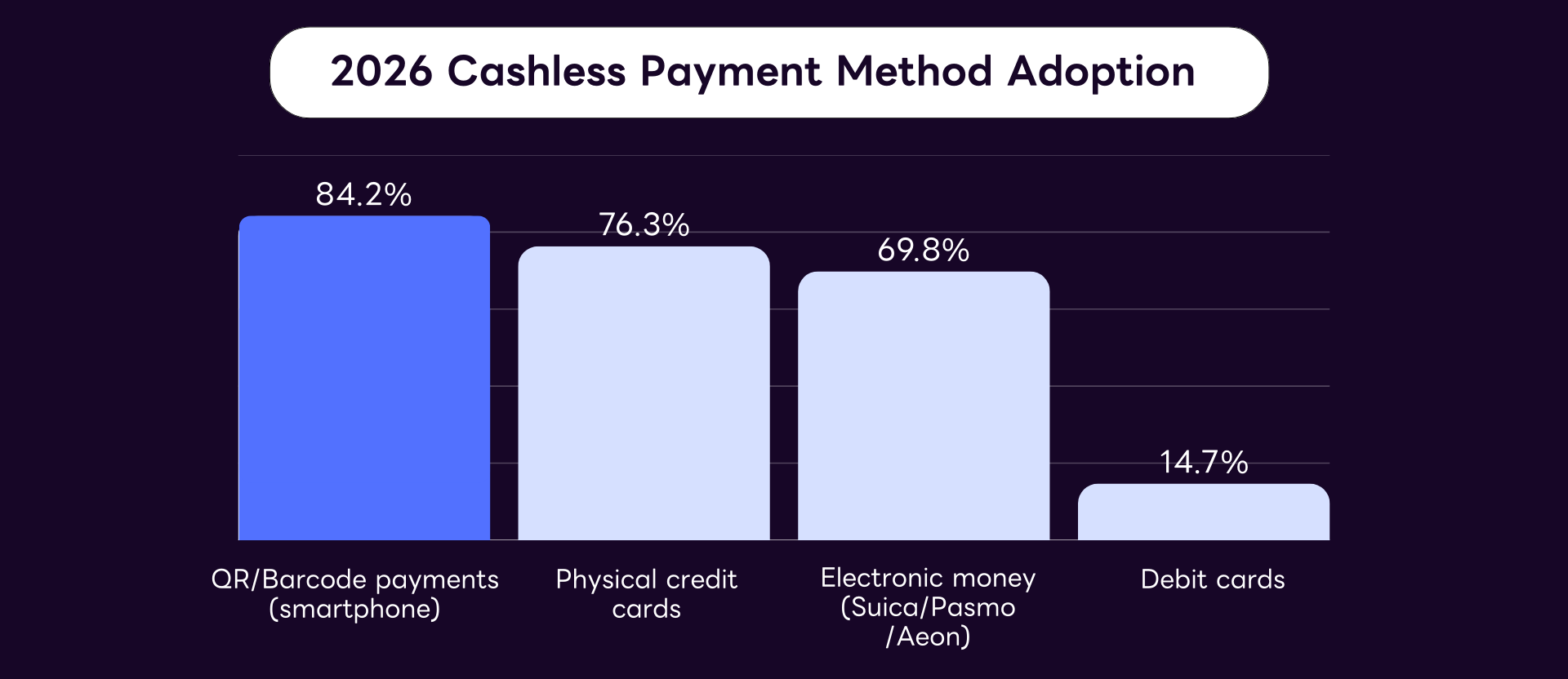
At the same time, cashless payments have transformed how Japanese consumers transact:
QR code payments have achieved 84.2% adoption, surpassing physical credit cards.
88.3% of people aged 15+ made a digital payment in the past year.
52.5% made an online or mobile purchase in the past year.
 Source: nippon.com
This shift places services like LINE, PayPay, and other QR wallets at the centre of Japanese consumer behaviour, making them critical touchpoints for discovery, purchase, and loyalty.
Implications for brands targeting Japanese consumer behaviour:
Design campaigns assuming the consumer is on a smartphone from first impression to checkout.
Use QR codes to bridge offline and online (scan-to-buy, scan-to-join, scan-to-coupon) in retail, OOH, and events.
Build journeys that integrate digital wallets and app deep links, reducing friction at payment.
The full 2026 Japanese Consumer Behaviour white paper includes practical guidance on optimising funnels for LINE, Yahoo! JAPAN, and QR-based activations.
Japanese consumer behaviour is not monolithic. In 2026, three major segments shape demand: the Silver market, Millennials, and Gen Z, each with distinct expectations and digital habits.
Japan remains a “super-aged” society, with 30.1% of the population aged 65+ and this cohort holding around 72% of national assets. Japanese consumer behaviour among seniors is shifting as more of them adopt smartphones for LINE communication and e-commerce, and roughly 30% of people aged 65–69 continue working.
Traits of Silver Japanese consumer behaviour:
💡 High asset ownership but cautious spending.
💡 Growing adoption of QR payments, driven by convenience and reward points.
💡 Strong preference for safety, reliability, and simplicity in product and UX design.

Millennials are central to Japanese consumer behaviour in urban markets. Dual-income households are becoming the norm, creating time scarcity and boosting demand for convenient, time-saving solutions.
Key elements of Millennial Japanese consumer behaviour:
💡 Preference for quality over quantity and values-driven consumption.
💡 Use of convenience stores, prepared foods, and services to manage busy lifestyles.
💡 Platform nativeness on LINE, Instagram, and YouTube.

Gen Z, or the Satori Generation, is redefining Japanese consumer behaviour around identity, community, and authenticity. They drive a 3.5 trillion yen oshikatsu economy, with 14 million participants spending about 250,000 yen annually per person.
Key features of Gen Z Japanese consumer behaviour:
💡 Emotional connection and identity alignment often outweigh functional benefits.
💡 High scepticism of inauthentic branding; about 71% place less importance on famous brand names.
💡 Video-first discovery on TikTok, YouTube Shorts, and Instagram Reels.

To reach these segments, marketers must design differentiated strategies rooted in the realities of Japanese consumer behaviour, not generic age brackets.
Oshikatsu—actively supporting a favourite idol, character, creator, or team—is now central to youth and fandom-driven Japanese consumer behaviour. With a market size of about 3.5 trillion yen, oshikatsu is economically larger than Japan’s video game software market and approaching the domestic auto parts industry.
Oshikatsu-related Japanese consumer behaviour includes spending on:
✅ Limited-edition and collaboration merchandise.
✅ Live events, concerts, meet-and-greets, and related travel.
✅ Pop-up cafés, exhibitions, and immersive experiences.
✅ Digital content, virtual meet-ups, and in-game purchases.
This experience-led Japanese consumer behaviour influences fashion, beauty, travel, and food, as fans seek products and experiences that connect them to communities and stories they care about. For brands, this means that tapping into fandoms, creator partnerships, and limited drops can significantly amplify engagement and conversion.
Sustainability is a core filter in Japanese consumer behaviour, but it operates differently than in many Western markets. Consumers prefer “silent sustainability,” expecting eco-conscious design and operations without aggressive ESG messaging.
Patterns in sustainable Japanese consumer behaviour:
Strong scepticism of greenwashing; claims must be backed by evidence or third-party certifications.
Preference for products that deliver tangible benefits like durability, resource efficiency, and safety.
Subtle cues—natural materials, minimalist aesthetics—resonate more than bold “eco” labels.
Generational nuances in Japanese consumer behaviour around sustainability:
Gen Z: strong interest in upcycled fashion, ethical sourcing, and circular models.
Millennials: willingness to pay more for truly sustainable, high-quality products.
Older generations: growing awareness, but with emphasis on practicality and health outcomes.
At the same time, wellness—particularly stress relief, mental health, and everyday comfort—is a major driver of Japanese consumer behaviour across categories. People are shifting from “more” to “better,” favouring fewer, higher-quality products and experiences that support a calmer, safer life.
To succeed in Japan, marketers must align strategy with the realities of Japanese consumer behaviour in 2026:
✅ Build value-led narratives that combine price incentives with quality and emotional benefits.
✅ Design mobile-native, QR-integrated journeys that reflect how Japanese consumers browse and pay.
✅ Segment communications for Silver, Millennial, and Gen Z audiences with tailored propositions.
✅ Leverage oshikatsu dynamics with fandom-friendly campaigns and collaboration-based experiences.
✅ Embed sustainability and wellness into products and experiences, communicating them credibly and subtly.
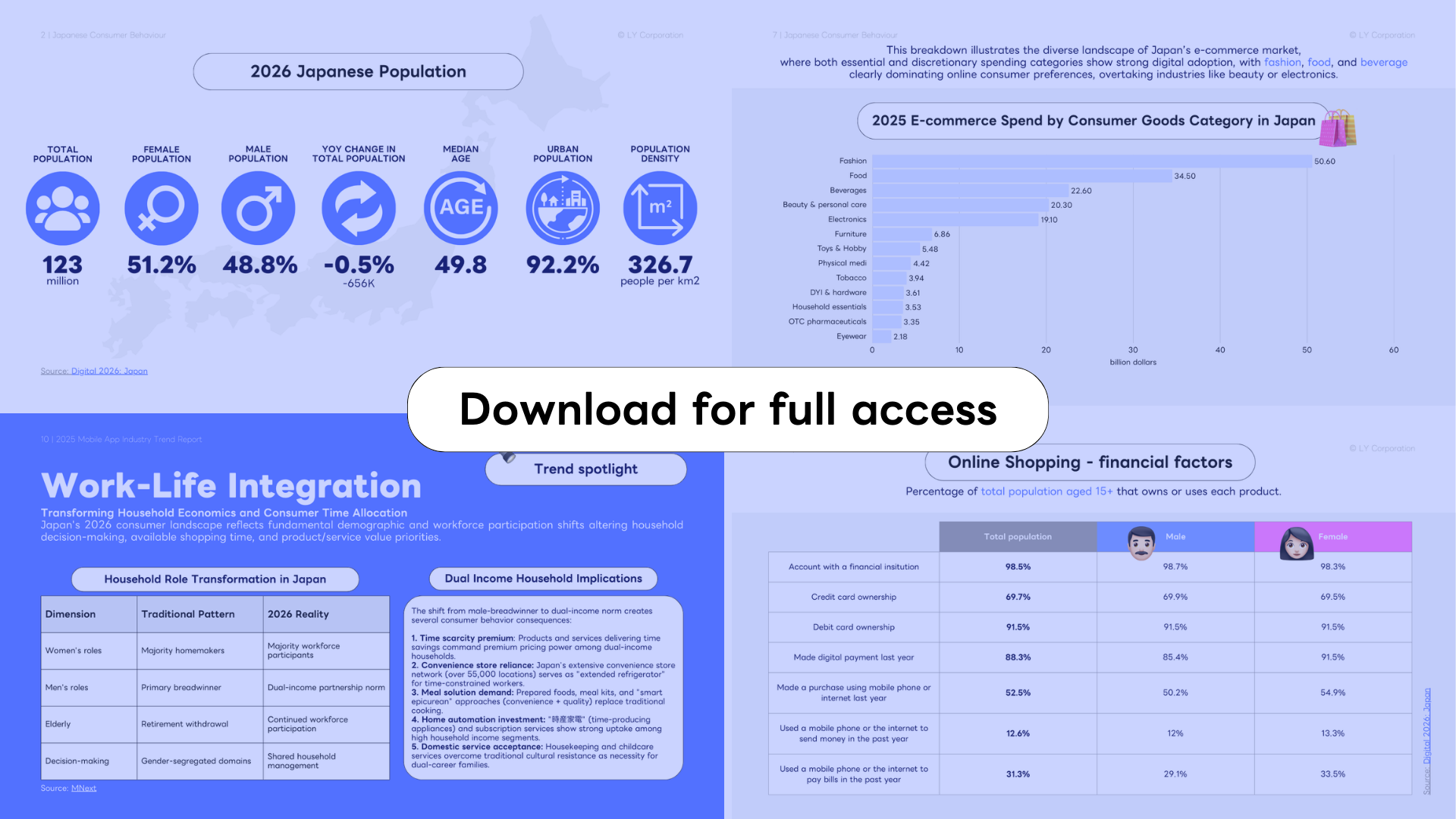
For a complete, data-backed guide to Japanese consumer behaviour in 2026 – including charts, personas, and platform playbooks for LINE and Yahoo! JAPAN – download the full white paper now.
The main trends in Japanese consumer behaviour include smart frugality due to persistent inflation, mobile-first and QR-first commerce, and increased reliance on digital ecosystems like LINE and PayPay. There is also a strong rise in experience-led spending through oshikatsu, growing attention to silent sustainability, and heightened focus on wellness and daily comfort.
Inflation has pushed Japanese consumers into a mode of smart frugality, where they prioritise value and carefully manage household budgets. Rather than cutting all discretionary spending, they look for free delivery, discounts, loyalty points, and high-quality products that justify their price and improve daily life.
Mobile and QR payments are central to Japanese consumer behaviour today. Over half of e-commerce volume comes from mobile devices, and QR payments have reached 84.2% adoption, surpassing physical credit cards. This means that Japanese consumers expect seamless mobile journeys, integrated wallets, and QR bridges between offline and online touchpoints.
Sustainability strongly influences Japanese consumer behaviour, but in a subtle way. Consumers favour products with embedded sustainable features—such as durability, resource efficiency, and safer ingredients—rather than overt green marketing. They are sceptical of unsubstantiated ESG claims and prefer clear proof and understated communication.
Brands should tailor their strategies to the specific dynamics of Japanese consumer behaviour: design mobile-first, QR-enabled journeys; use value-driven yet quality-oriented messaging; segment for Silver, Millennial, and Gen Z audiences; and tap into fandom cultures and experience-led campaigns. Embedding sustainability and wellness into offerings, and communicating them with credibility and subtlety, is increasingly essential for long-term success.
We are official media reps for LINE and Yahoo! JAPAN platforms. This means that we are able to provide our clients with comprehensive support services completely free of charge.
 A dedicated specialist provides strategic guidance and operational support, free of charge.
Comprehensive support from account creation to set up and activation.
No contracts or minimum needed.
The latest information such as market trends and industry insights to help your planning.