Insights >
Advertising financial solutions in Japan


New: LINE Yahoo Ads Media Guide | download for FREE >>
Japan’s financial sector is experiencing an historic transformation that presents unprecedented opportunities for international service providers and investors alike. With household financial assets totalling ¥2,230 trillion ($14.2 trillion) in December 2024 – and projected to grow 15% to reach ¥2,500 trillion by 2030 – Japan’s economy is entering a new era of dynamic wealth management and investment growth. This is the best time to start advertising financial solutions in Japan.
What makes this moment particularly significant? Japan is pivoting away from decades of cash-hoarding behavior. With 51% of household assets currently held in cash compared to just 12% for Americans, a fundamental shift in investor mindset is driving unprecedented fund flows into investment products. The expanded NISA (Nippon Individual Savings Account) program alone generated ¥15 trillion in annualized fund inflows during its first year, signalling a generational change in how Japanese households approach wealth preservation and growth.
This article explores the key trends reshaping Japan’s financial landscape and the strategic imperatives for market participants.
Table of Contents
Three powerful forces are converging to reshape Japan’s financial ecosystem:
For decades, Japan’s households optimized their financial behaviour around persistent deflation – hoarding cash and maintaining ultra-conservative investment postures. Today, that calculus has fundamentally changed. Japan’s economy is experiencing moderate inflation, profoundly altering investor psychology.
Households that previously viewed cash savings as their primary financial goal are now focused on protecting their assets against purchasing power erosion. Recent data shows declining inflows to cash and savings deposits, while outflows from low-interest accounts have accelerated. Simultaneously, inflows to stocks and risk assets are surging – signalling a historic reallocation of capital from defensive to growth-oriented holdings.

The expanded NISA program, launched in January 2024, has fundamentally changed the retail investment landscape. This tax-exempt investment system operates similarly to how IRAs transformed retirement savings in the United States during the 1970s – but NISA’s impact in Japan has been even more dramatic.

Within just twelve months, NISA attracted ¥15 trillion in annualized fund inflows. For context: this single program is driving more capital into retail investment markets than many countries’ entire investment ecosystems manage. The message is clear – Japanese investors are ready to move money into professional investment vehicles when given the right structure and tax incentives.
Japan’s financial consumers are embracing digital transformation at remarkable speed. Digital banking, which reached $612.02 million in 2024, is projected to grow to $1,682.24 million by 2033 at an 11.89% compound annual growth rate. Mobile banking adoption is accelerating, with 65% of Japanese investors now managing investments online or via apps.
This digital momentum creates an ideal environment for financial service providers to reach Japanese consumers through strategic digital channels – particularly Yahoo! JAPAN, which remains the dominant financial platform in the Japanese market.
Japan’s financial market is not monolithic. Different sectors are experiencing distinct growth trajectories:
⭐️ Asset Management is leading the charge, projected to grow from $27.70 billion in 2024 to $63.00 billion by 2033 (9.51% CAGR). The Government Pension Investment Fund (GPIF), managing the world’s largest pension fund at $1.7 trillion, has shifted toward “sustainability-conscious investment” strategies aligned with global ESG trends.
⭐️ Fintech represents the fastest-growing segment, expanding from $9.2 billion today to $30.2 billion by 2033 (14.1% CAGR). This explosive growth reflects digital transformation, cashless payment adoption, and supportive government regulatory frameworks.
⭐️ Banking and Lending remain robust, with outstanding loans reaching $4.28 trillion (¥635.47 trillion) as of February 2025—a 3.1% year-over-year increase. The Bank of Japan’s policy rate normalization is creating additional tailwinds, with the policy rate expected to reach 0.75% by end of 2025.
⭐️ Wealth Management is expanding at 4.12% CAGR, driven by an aging population with sophisticated service demands and a rising class of affluent individuals seeking professional guidance.
Download our FREE Japanese Finance Industry trend report here →

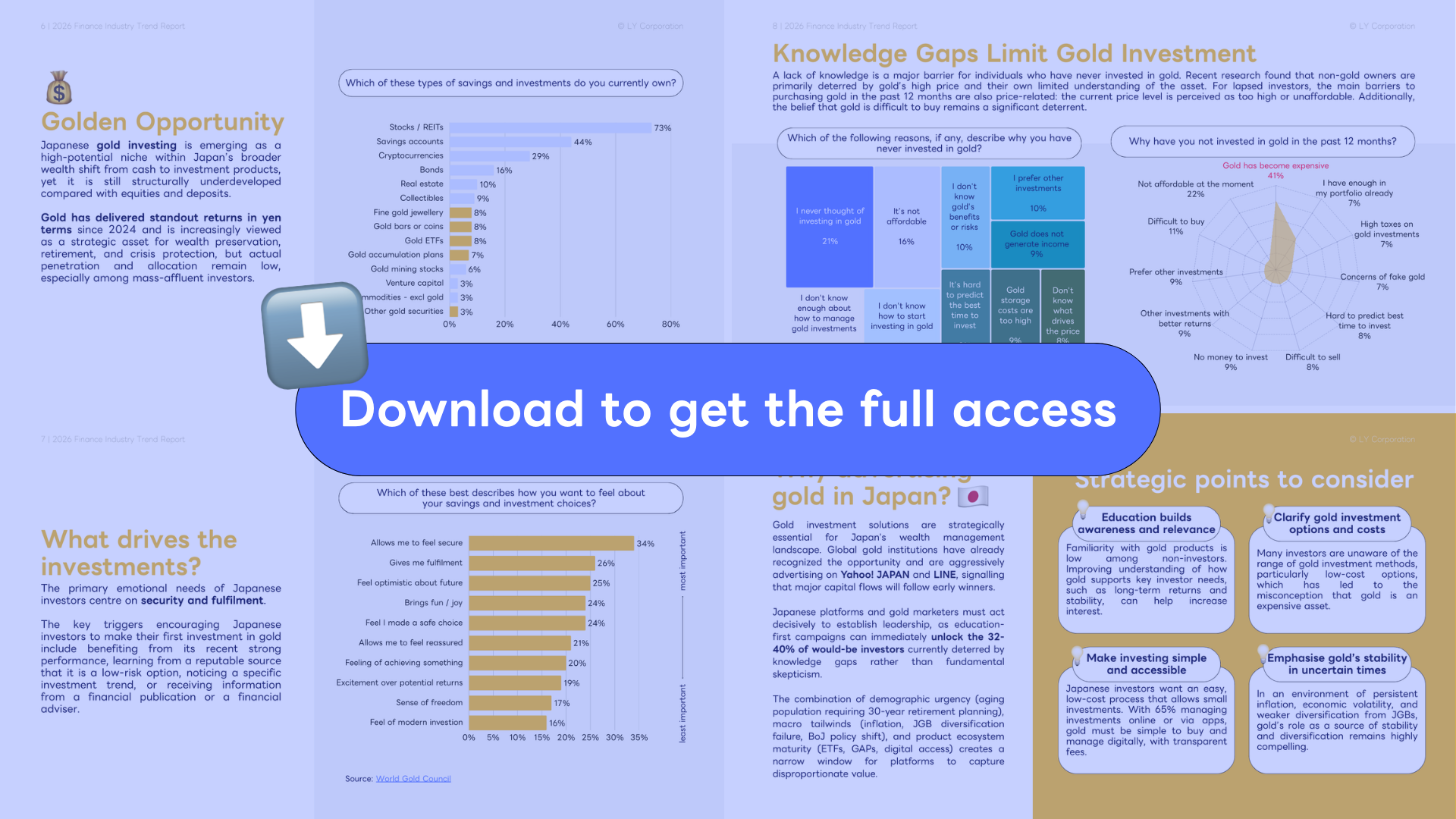
Within Japan’s broader wealth shift lies a fascinating micro-market: gold investment. While 73% of Japanese investors hold stocks or REITs, only 9-10% own any form of gold – whether bars, coins, ETFs, or accumulation plans. This represents a dramatic disconnect given Japan’s demographic profile, economic conditions, and gold’s compelling value proposition.
Why is gold penetration so low? The answer reveals a critical marketing opportunity.
Research shows that knowledge gaps, not skepticism, are the primary barrier. The leading reasons non-investors cite for never owning gold are:
Among lapsed investors (those who haven’t purchased in the past 12 months), 41% cite affordability as their primary concern—but this reflects perception rather than reality. Many Japanese investors remain unaware that gold investment options exist at price points accessible to mass-affluent investors through ETFs, gold accumulation plans, and lower-cost products.
The emotional drivers are equally compelling. When asked what they want to feel about their savings and investments, Japanese investors prioritize:
Gold’s value proposition – offering both tangible security and portfolio stability in uncertain times – aligns perfectly with these emotional needs. Yet this alignment remains largely unknown to the very investors who would benefit most from gold exposure.
For international gold institutions and Japanese platforms alike, education-driven campaigns represent an immediate unlocking opportunity, with 32-40% of would-be investors currently deterred by knowledge gaps rather than fundamental objections to gold itself.
Download our FREE Japanese Finance Industry trend report here →
Understanding how Japanese investors actually make financial decisions is essential for market participants. Key behavioural insights include:
💡Digital-first decision making: Approximately 65% of Japanese investors manage their portfolios online or via mobile applications. This digital orientation creates significant opportunities for platforms offering seamless, intuitive digital experiences with transparent fee structures and ease of use.
💡 Trust in reputable sources: Japanese investors cite learning from reputable sources that an investment is “low-risk” as a critical trigger for their first investment. This explains why traditional financial advisers, publications, and established platforms maintain disproportionate influence in the decision-making process.
💡 Trend awareness: Noticing specific investment trends and receiving information from financial publications are significant motivators. Investors want to understand whether an asset is gaining traction and whether peers are adopting similar strategies.
💡 Research-oriented: Japanese investors conduct in-depth research before making high-value financial decisions. This extended consideration cycle contrasts with the quick-search behaviour typical of younger, digital-native demographics. Yahoo! JAPAN’s research-oriented user base is therefore particularly well-suited to reaching business decision-makers and serious investors.
NISA (Nippon Individual Savings Account) is Japan’s tax-exempt investment system that allows individuals to invest without paying capital gains or dividend taxes on investment returns. The expanded NISA program, launched in January 2024, generated ¥15 trillion in annualized fund inflows within its first year—larger than many countries’ entire investment markets. It represents a structural shift that will drive retail investment growth for decades.
Decades of deflation created a cultural preference for cash savings, where money preserved purchasing power without investment risk. As Japan transitions to moderate inflation, this calculus has changed. Households now recognize that cash savings erode in real value, driving a historic shift into risk assets.
Yes. Japan’s financial system maintains remarkable stability with sufficient capital bases and funding to withstand various stress scenarios. With outstanding loans at $4.28 trillion (3.1% YoY growth) and the Bank of Japan’s policy rate normalization process well underway, the banking system is positioned for continued growth.
Three factors: digital transformation of financial services, rapid adoption of cashless payments, and supportive government regulatory frameworks. The fintech sector is projected to grow from $9.2 billion today to $30.2 billion by 2033 (14.1% CAGR)—making it the fastest-growing financial services segment.
Research indicates that knowledge gaps, rather than skepticism, are the primary barrier. 21% of non-investors have “never thought of” gold, while 16% believe it’s unaffordable due to unfamiliarity with accessible gold investment vehicles like ETFs and accumulation plans. Education-driven campaigns can unlock significant untapped demand.
The most effective approach combines three elements: Yahoo! JAPAN advertising (where B2B and financial service conversions significantly outperform Google), native content in Japanese, and long-term strategic commitment rather than opportunistic short-term tactics. Regulatory compliance—particularly for financial services and cryptocurrency advertising—requires early engagement with local legal expertise.
Japan’s aging population creates urgent retirement planning needs and significant wealth transfer dynamics. Insurance sector growth is driven by increasing life expectancy and evolving risk management needs. Asset management and wealth management are growing as affluent retirees seek professional guidance.
The shift is already underway. Investment trusts surged 27.4%, stock holdings grew 9.5%, and NISA inflows reached ¥15 trillion in annualized terms. Expect acceleration throughout 2025-2027 as behavioral changes compound and institutional infrastructure matures.
Financial services advertising requires registration with relevant authorities and clear disclosure of costs and trading risks. Cryptocurrency-related advertising has additional requirements including FSA registration. Early engagement with local compliance expertise is essential but does not represent an insurmountable barrier.
Yahoo! JAPAN demonstrates superior performance for B2B financial services compared to Google, offering better CPA and ROAS due to its business professional user base and research-oriented user behaviour. Yahoo! JAPAN Finance attracts over 1 million app users and reaches the country’s most engaged investor demographic.
Japan’s financial transformation represents far more than cyclical market activity. It reflects fundamental demographic, economic, and psychological shifts that will reshape capital allocation for decades. The convergence of NISA expansion, inflation awareness, digital adoption, and an aging population creates a rare window where structural change accelerates capital redeployment.
For service providers positioned correctly – with digital-first platforms, educational content, and strategic advertising on platforms like Yahoo! JAPAN – this represents the opportunity to capture disproportionate value as $14.2 trillion in household assets undergoes historic reallocation.
The question is no longer whether Japan’s financial markets will transform. The question is who will lead that transformation.
We are official overseas media representatives for LINE Yahoo advertising products. We provide complimentary support to clients who manage their own ad accounts.
Click here to contact our team and discuss how we can support your brand in Japan.