Insights >
The Future of Ad Targeting in Japan

New: LINE Yahoo Ads Media Guide | download for FREE >>
As digital advertising evolves globally, Japan’s market is undergoing a significant transformation. Privacy rules are increasing, third-party cookies are being phased out, and consumer expectations are changing.
These factors are changing how marketers connect with Japanese audiences. Two platforms are leading this charge: Yahoo! JAPAN and LINE.
This guide explains the difference between first-party and third-party data targeting. Whether you’re comparing Google Display Network (GDN) to Yahoo! Display Ads (YDA), or learning how to build sustainable marketing strategies using LINE and Yahoo! JAPAN, this article provides the insights you need to succeed.
Table of Contents
Third-party data is information collected by external vendors and resold to advertisers. These data brokers aggregate information from various websites and sources, creating broad audience segments based on browsing behavior, demographics, interests, and purchase history. For many years, third-party data has supported digital advertising. It helps marketers reach large audiences on different websites and platforms.
However, third-party data has significant limitations:
⚠️ Accuracy concerns: Information is often outdated, inaccurate, or lacks context
⚠️ Privacy vulnerabilities: Users have limited awareness and control over how their data is collected and used
⚠️ Lack of ownership: You don’t own the relationship with the audience
⚠️ Regulatory risk: Privacy legislation increasingly restricts third-party data use

First-party data is information you collect directly from your audience and customers. This includes browsing behavior on your website, purchase history, email engagement, customer interactions, and explicit preferences provided by users. Essentially, first-party data comes from direct interactions with your brand.
First-party data offers critical advantages:
✅ Higher accuracy: Directly reflects actual customer behavior and preferences
✅ Greater relevance: Enables granular, personalized marketing campaigns
✅ Ownership of relationship: You own the customer relationship, not a third-party broker
✅ Regulatory compliance: Aligns with privacy legislation like Japan’s APPI
✅ Cost efficiency: Research shows first-party data can reduce customer acquisition costs by up to 50% compared to traditional targeting methods
✅ Better predictive capability: Enables accurate forecasting of future customer behavior
Recent research shows that first-party data is becoming a strong alternative to third-party data. This is especially true as advertising rules change. Advertisers increasingly recognize first-party data as the most reliable and valuable approach for improving targeting accuracy and campaign performance.
Japanese marketing experts emphasize that as third-party cookies disappear, first-party data combined with LINE and Yahoo! JAPAN’s proprietary data represents the future of effective digital advertising in Japan.
💡Enhanced precision targeting
First-party data enables precise audience segmentation based on actual behavior. Instead of focusing on broad groups, you can create segments based on specific actions.
These actions involve users who:
This precision directly translates to higher conversion rates.
💡Improved ROI and cost efficiency
With first-party data, every marketing dollar works harder. By targeting users most likely to convert‚ based on their demonstrated interest and behavior‚ you achieve higher return on investment.
Research confirms that campaigns using first-party data outperform those relying on broad third-party segments. One Japanese case study shows this clearly. A SaaS company used LINE Official Account data. They saw a 20% increase in application submissions. This happened within months of using first-party targeting strategies.
💡Privacy compliance and trust
First-party data collection involves explicit user consent and transparency. In Japan’s strict regulatory environment (more on this below), this approach ensures compliance while building consumer trust. Users appreciate knowing exactly how their data is used and willingly share information with brands they trust.
💡Future-proof marketing strategy
As third-party cookies phase out and privacy regulations tighten globally, marketers who rely solely on third-party data face an uncertain future. Deloitte research shows that 61% of high-growth companies are shifting toward first-party data strategies.
This isn’t a temporary trend‚ it’s the permanent future of digital advertising. Japanese advertising platforms have already begun this transition: Yahoo! JAPAN’s 2025-2026 roadmap emphasizes SoftBank mobile network first-party data combined with customer site data for privacy-compliant targeting.
💡Deeper customer understanding
First-party data provides qualitative insights that third-party aggregates cannot match. You know who your customers are and why they connect with your brand. You understand the problems you solve for them and how to meet their needs better. This intelligence fuels superior marketing, product development, and customer service.
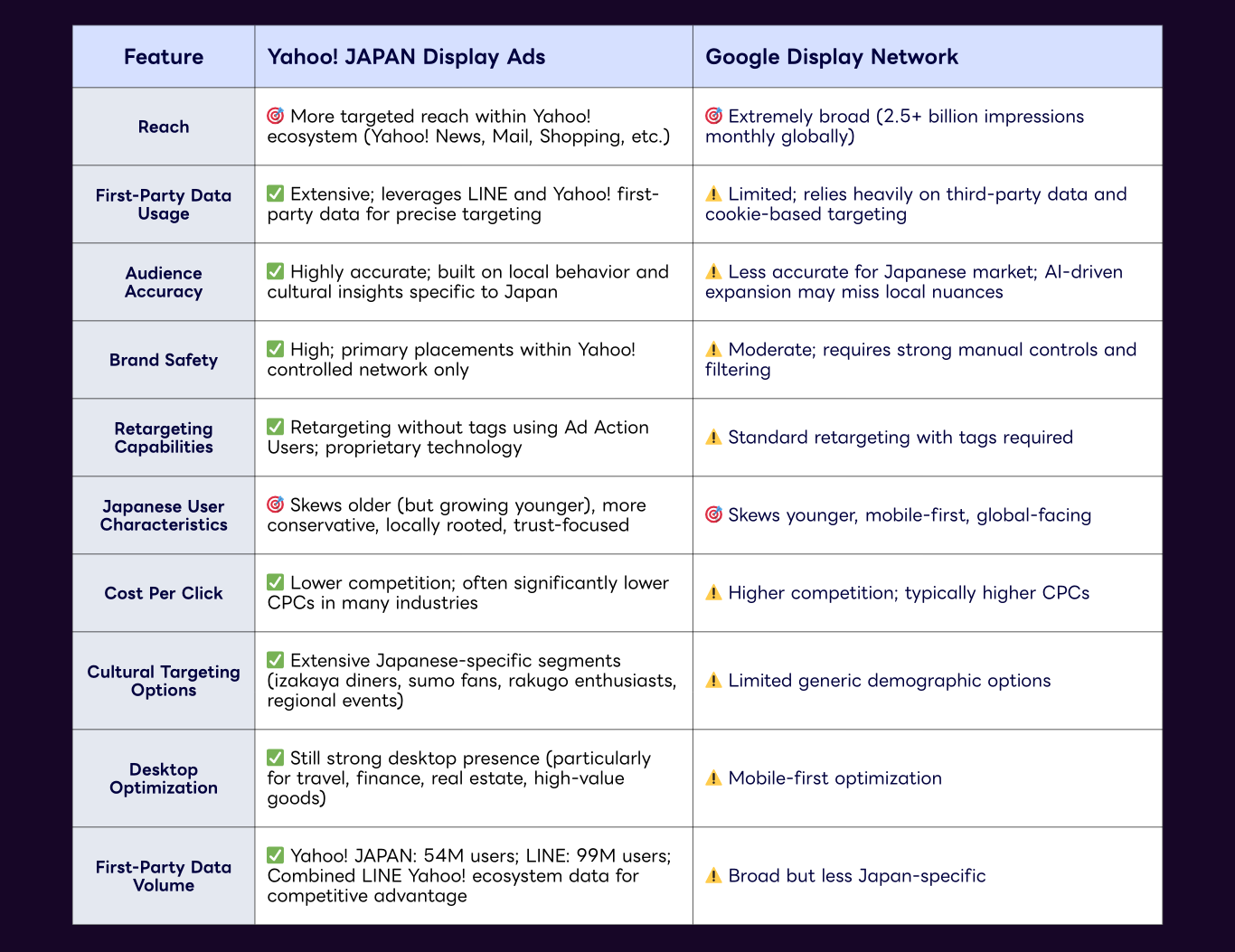
For marketers operating in Japan, understanding the differences between Google’s Display Network and Yahoo! JAPAN’s Display Ads is crucial. While both platforms offer display advertising capabilities, they differ significantly in reach, data capabilities, brand safety, and audience characteristics.
✅ First-Party Data Advantage
Yahoo! JAPAN’s integration with LINE‚ Japan’s dominant communication platform with 99 million monthly active users‚ provides unmatched first-party data. YDA can leverage behavioral signals, transaction history, and communication patterns that GDN simply cannot access in the Japanese market.
The LINE Yahoo! merger in 2023 created an unprecedented data advantage: Yahoo! News (54M users), Yahoo! Mail, Yahoo! Shopping, combined with LINE’s 99 million users, creates a first-party data ecosystem unmatched by any global competitor.
✅ Cultural Relevance
GDN’s global algorithms don’t fully capture Japanese consumer behavior, seasonal patterns, and cultural preferences. YDA’s audience segments reflect deep knowledge of local interests: seasonal events (Cherry Blossom season, Obon, typhoon season), regional festivals, traditional entertainment preferences, and more. Japanese ad tech companies specifically note that YDA enables precise targeting based on Japanese consumer psychology and behavior patterns that global platforms cannot match.
✅ Lower Competition
Many global brands overlook Yahoo! JAPAN, focusing exclusively on Google. This reduced competition means lower cost-per-click for advertisers who embrace the platform‚ sometimes dramatically lower across industries like real estate, travel, finance, and events.
✅ Brand Safety
YDA’s advertising placements occur exclusively within Yahoo! JAPAN’s controlled, premium properties. Google Display Network’s broader reach across millions of partner websites introduces greater brand safety risk, requiring more sophisticated manual controls.
✅ Audience Alignment
Yahoo! users in Japan tend to be older, more conservative, and more locally focused than Google users. For luxury brands, financial services, travel, and other categories targeting affluent Japanese consumers with significant purchasing power, this alignment is crucial. Recent updates to YDA enable advanced segmentation, including geographic targeting within specific radius zones, enabling hyper-local campaigns.
Discover everything you need to know about advertising on Yahoo! JAPAN →

Japan’s approach to data privacy and protection is among the world’s strictest. The Act on the Protection of Personal Information (APPI) requires careful compliance, but it also creates opportunity for marketers who leverage first-party data effectively.
🔐 Japan’s APPI Framework
The APPI, significantly amended in 2020 and 2022, is now closely aligned with Europe’s GDPR and represents the most comprehensive privacy legislation in Asia. Key principles include:
Japanese organizations must treat APPI compliance as foundational to all data processing, not as a checkbox. The law applies to all organizations handling Japanese resident data, regardless of where the organization is located.
🔐 Compliance Requirements for Ad Tracking
While cookies themselves are not directly regulated under APPI (cookies are not classified as personal information on their own), significant restrictions apply.
Consent Required When:
No Consent Required For:
The APPI Enforcement Landscape
Japan’s Personal Information Protection Commission (PPC) actively enforces APPI requirements and has demonstrated its commitment through high-profile enforcement actions:
-Rikunabi Case: A job-seeking platform was required to cease using cookies without consent to track student browsing history and profile their likelihood of declining job offers. The PPC ruled that behavioral tracking cookies constitute “person-related information” requiring consent.
Penalties for Non-Compliance:
⚠️ Third-Party Cookie Tracking Restrictions
Most traditional behavioral ad tracking across multiple websites requires explicit APPI consent. The default assumption is that users have NOT consented. Advertisers cannot assume consent or use dark patterns to trick users into consent. According to Japanese data protection guidance, any individual user tracking (combining IP address with browsing history) requires affirmative consent before implementation.
⚠️ Tracking Technology Limitations
Any technology that enables individual user tracking (web beacons, pixels, fingerprinting techniques) requires either:
⚠️ First-Party Data as Competitive Advantage
Since first-party data collection occurs within your direct relationship with customers (with their knowledge and explicit consent), it remains fully compliant. This creates a significant competitive advantage for brands that build first-party relationships while competitors struggle with legacy third-party cookie approaches.
⚠️ Cross-Border Data Transfer Restrictions
If you’re based outside Japan, any data from Japanese users cannot be freely transferred internationally. You must ensure adequate data protection levels or obtain explicit consent for cross-border transfers.
Practical Implication: Leading global brands increasingly establish local data processing infrastructure in Japan to comply with APPI and maintain competitive advantage.
To succeed in Japan’s digital advertising landscape, you need integrated strategies across LINE and Yahoo! JAPAN. These platforms represent both complementary strengths and essential coverage of Japan’s digital ecosystem.
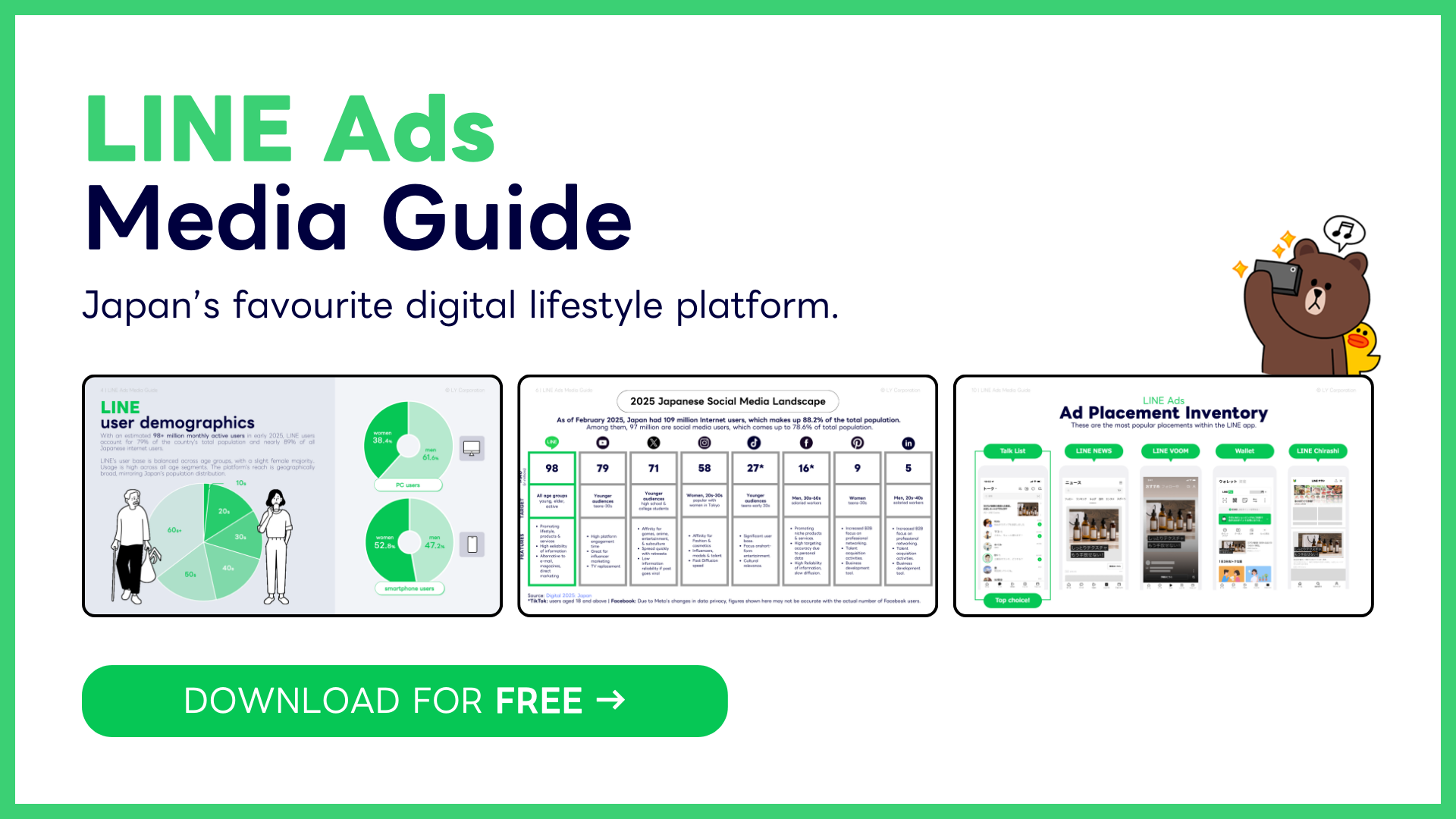
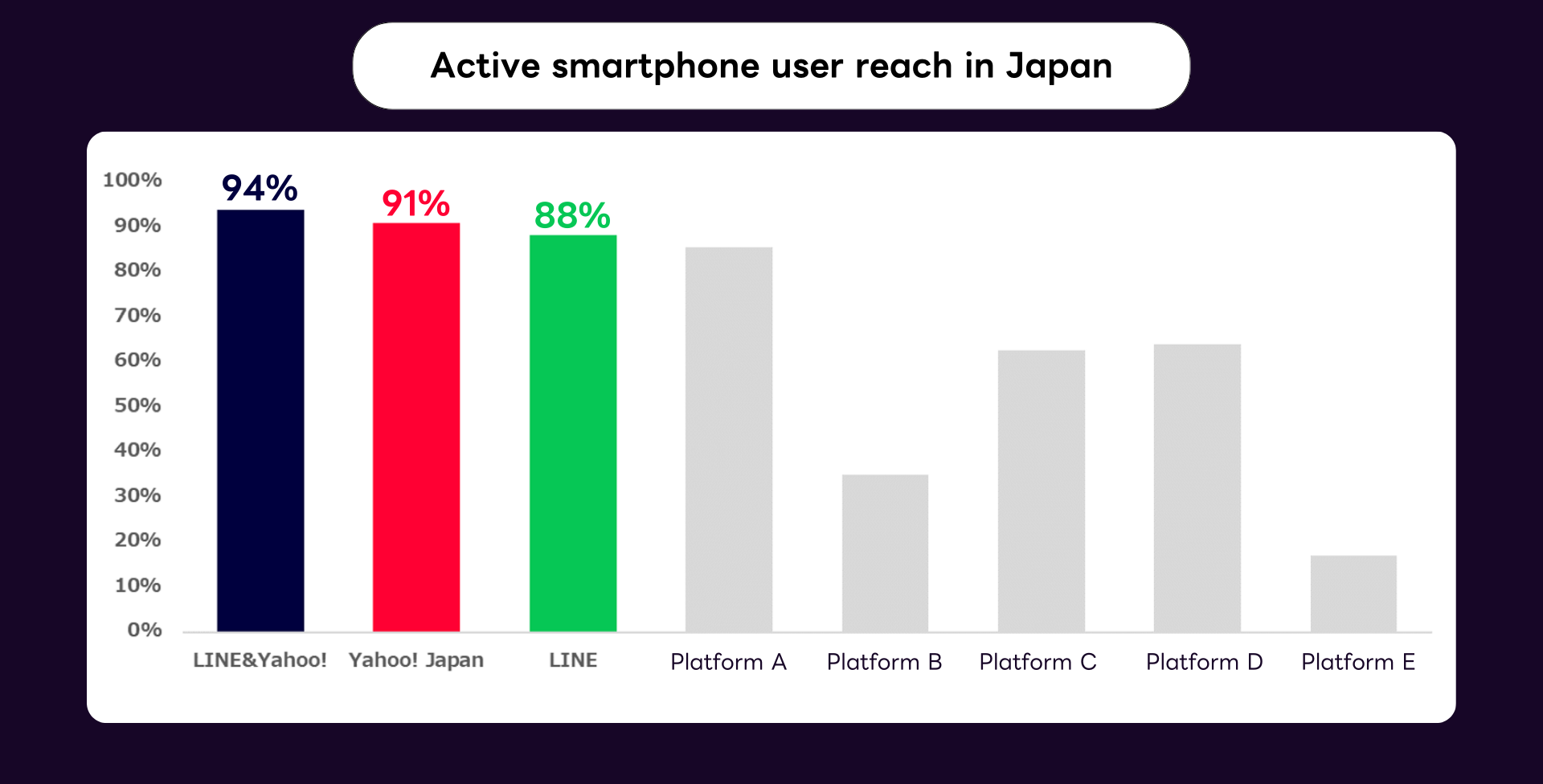
LINE is Japan’s digital infrastructure, not just an app. With 99 million monthly users (80%+ population penetration) and 85% daily active usage, it reaches virtually everyone from teens to seniors.
Its first-party data is unmatched—messaging, payments, shopping, and news signals combine with Yahoo! JAPAN data for precision targeting that survives cookie deprecation. One platform delivers everything: Official Accounts for CRM, LINE Ads for acquisition, LINE Shopping/Pay for commerce, and stickers for engagement.
Download our FREE LINE Ads Media Guide here →
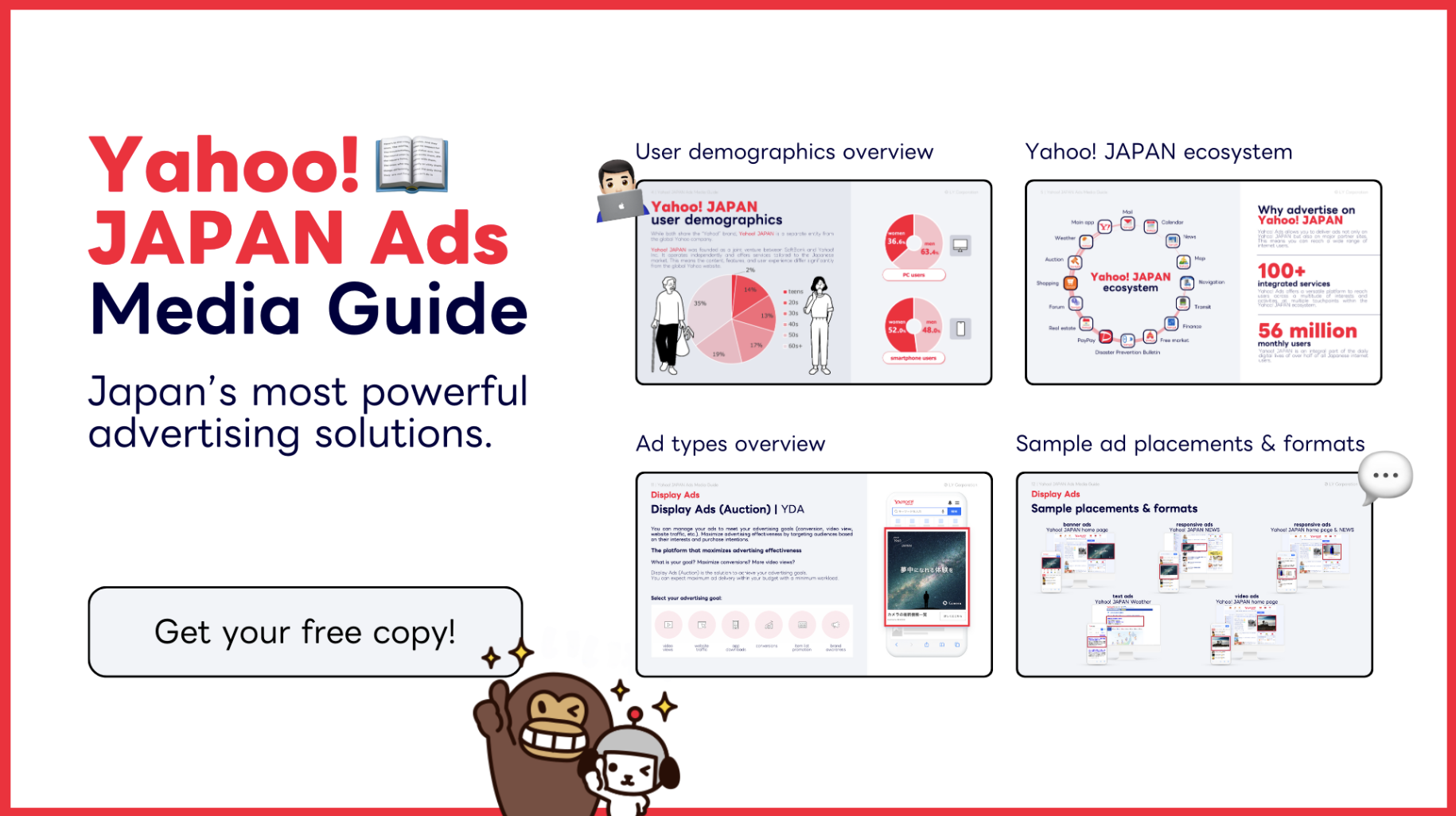
Yahoo! JAPAN captures older, affluent desktop users that LINE doesn’t fully reach—100 billion annual searches, strong in finance/travel/real estate.
Key advantages include tagless retargeting (APPI-compliant), Audience Discovery from combined LINE-Yahoo data, seasonal templates (Golden Week, Hanami), and hands-on account support that beats Google’s self-serve model.
Together, they create comprehensive coverage with Japan-specific first-party precision global platforms can’t match.
Download our FREE Yahoo! JAPAN Media Guide here →
An integrated LINE and Yahoo! JAPAN strategy works best when each platform covers a different part of the funnel. Yahoo! Display Ads builds brand awareness and captures seasonal and search-led intent, while LINE Ads focuses on broad customer acquisition, video engagement, and lifestyle positioning.
From there, LINE Official Accounts deepen direct relationships and collect zero-party data, and Yahoo! Search Ads convert high-intent users who are actively comparing options. Retargeting then ties everything together, using YDA to re-engage site visitors in the Yahoo! ecosystem and LINE Ads to reinforce messages across devices.
The real benefit comes from combining Yahoo! search and content data with LINE engagement signals. This creates a detailed view of user behavior that follows Japan’s privacy rules. This owned-data approach lowers reliance on third-party cookies. It is also more resistant to regulatory changes.
Japanese case studies show that using Yahoo! JAPAN common audiences with LINE Ads can boost conversion rates by about 195%. This is compared to campaigns that use only one platform.
Read our blog to discover 5 reasons you have to advertise on both LINE and Yahoo! JAPAN →

No. YDA uses “Ad Action Users” for tagless retargeting, which is APPI-compliant and cookie-independent, unlike GDN’s tag-based approach.
Auction ads start at ¥100/day for testing; Guaranteed Ads typically require ¥200K-¥500K minimum commitment for premium placements.
Yes – foreign brands advertise via LINE Official Accounts, with some exceptions. Please contact our team to learn more.
Typically 20-30% lower CPCs due to less competition, especially in finance, real estate, and travel categories.
YAD leverages combined LINE-Yahoo! first-party data for precise targeting based on search, content, and behavioral signals across their ecosystem.
The future of advertising in Japan belongs to brands that master first-party data strategies. As third-party cookies fade and privacy regulations tighten, your ability to build direct, transparent customer relationships becomes your competitive advantage.
Yahoo! JAPAN and LINE represent the optimal integrated platform strategy for Japanese marketing. Yahoo! JAPAN provides unmatched first-party data, lower competition, cultural relevance, and superior brand safety for awareness campaigns and search targeting. LINE delivers direct customer relationships, exceptional reach across all demographics, and transparent first-party data collection through Official Accounts and engagement.
By combining both platforms, implementing APPI-compliant first-party data strategies, and embracing the Japanese values of trust and transparency, you’ll build sustainable marketing capabilities that outperform competitors relying on legacy third-party approaches.
The same opportunity awaits your brand. Start building your LINE Official Account today, integrate Yahoo! JAPAN into your media mix, and begin the journey toward a first-party data strategy that respects Japanese privacy values while delivering exceptional marketing performance.
We are official overseas media reps for LINE Yahoo! advertising products. We provide clients with 100% free support, a dedicated account manager, and the latest market insights.
Click here to contact our team and discuss how we can support your brand in advertising in Japan.